DACStore Information materials & interesting links
Interesting Links
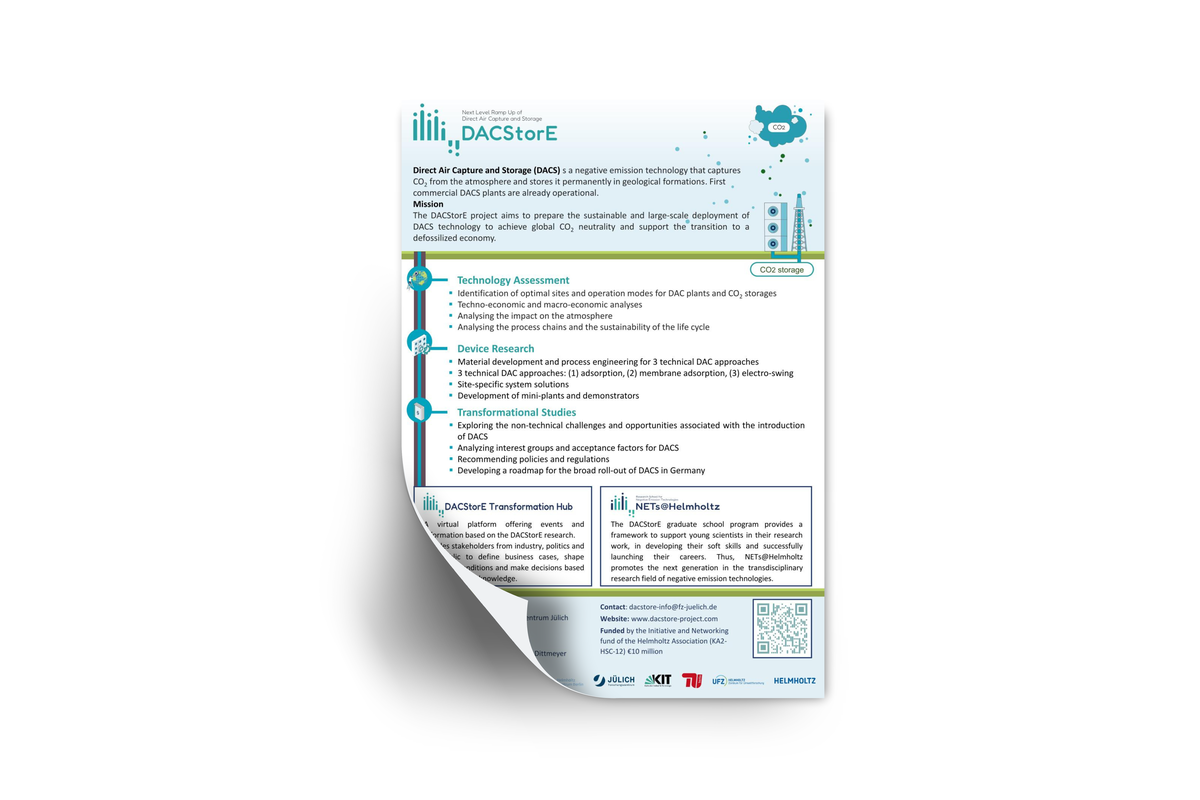
The DACStorE Project Flyer
The DACStorE project is investigating the potential, challenges and prerequisites for the sustainable and large-scale use of direct air capture and storage as a negative emission technology. It brings together research on technical DAC approaches, site and system analyses, and economic, ecological, legal and social issues. The aim is to prepare for the responsible ramp-up of DACS and to provide a sound basis for decision-making in politics, business and society in order to support the transformation to a defossilised and carbon-neutral economy.
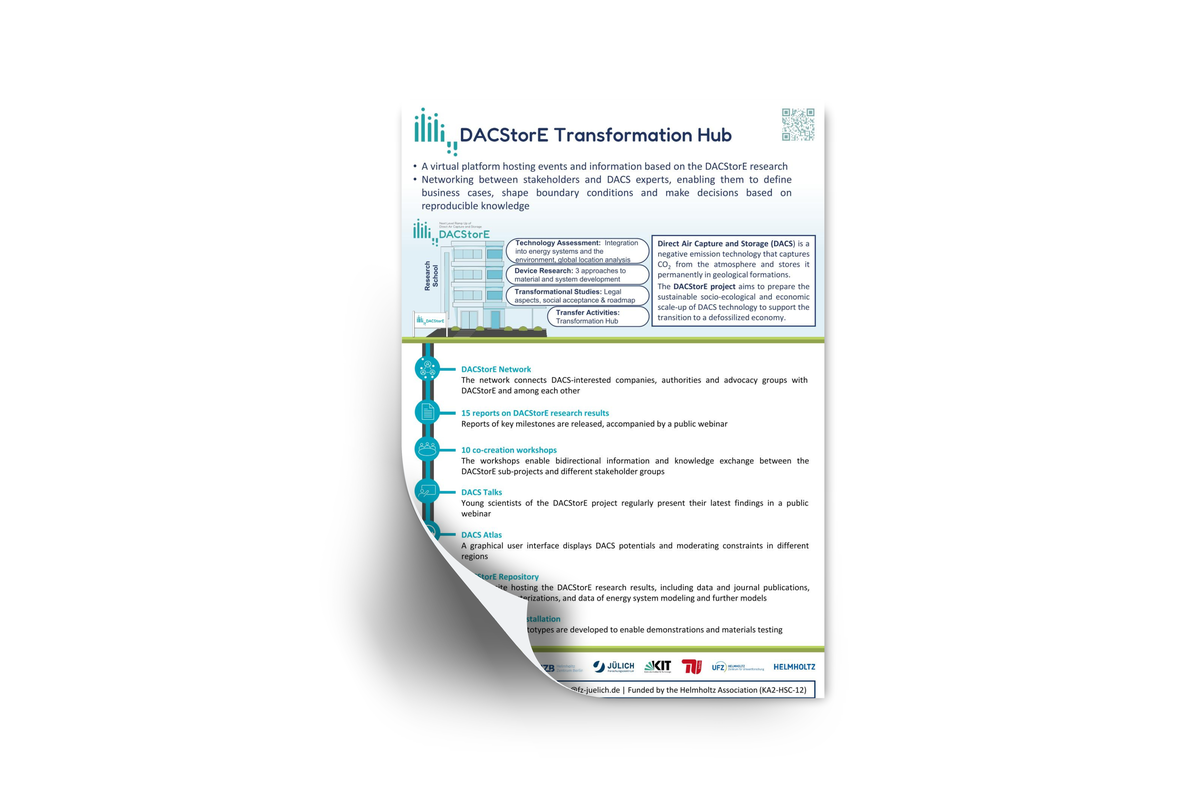
The DACStorE Transformation Hub Flyer
The DACStorE Transformation Hub is a central exchange and networking platform for stakeholders involved in direct air carbon capture and storage (DACCS). It brings together research results from the DACStorE project and connects companies, public authorities, civil society and academia to support the sustainable ramp-up of DACCS. The hub offers events, workshops, data and tools that enable informed decisions and address the socio-ecological, technical and economic conditions for the responsible use of DACCS in the transition to a defossilised economy.
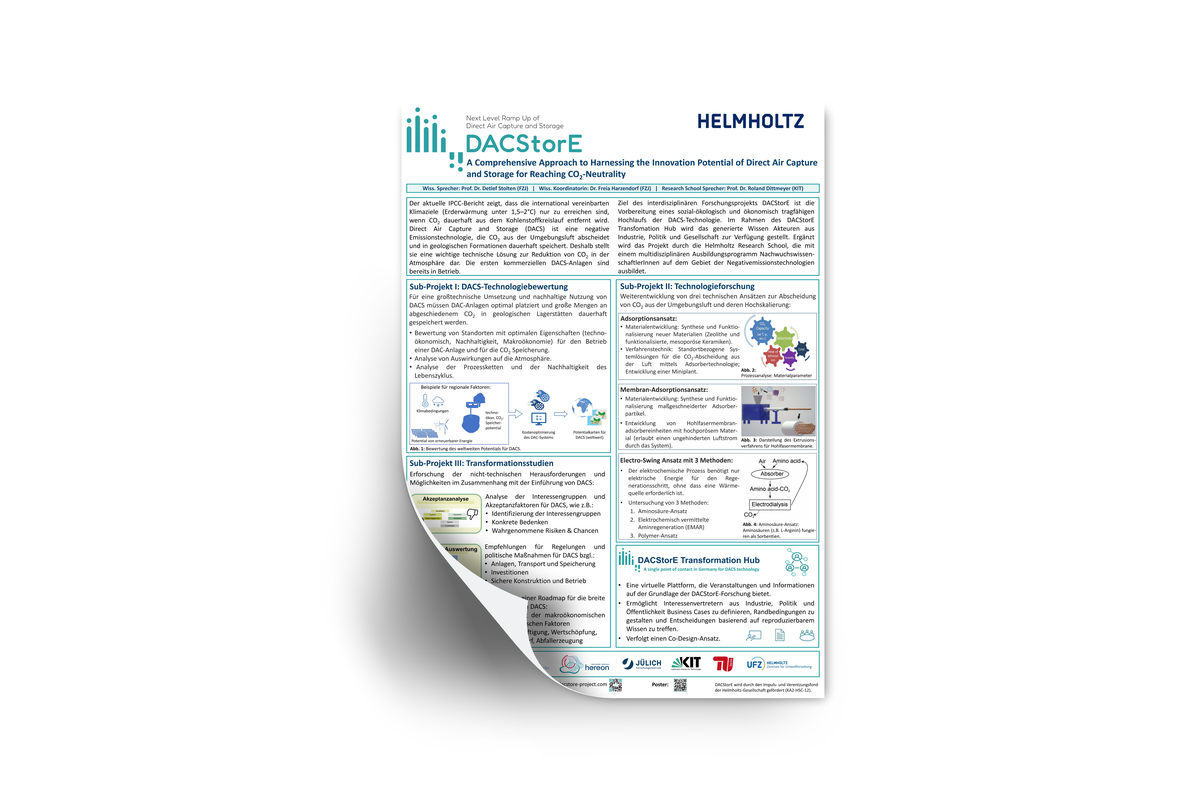
The DACStorE Project Poster
Against the backdrop of international climate targets, DACStorE analyses technological approaches to CO₂ capture from the air, evaluates location and system options, and assesses ecological, economic, legal and social conditions. The aim is to prepare for the responsible ramp-up of DACS on a sound scientific basis and to provide a robust basis for decision-making by politicians, industry and society.
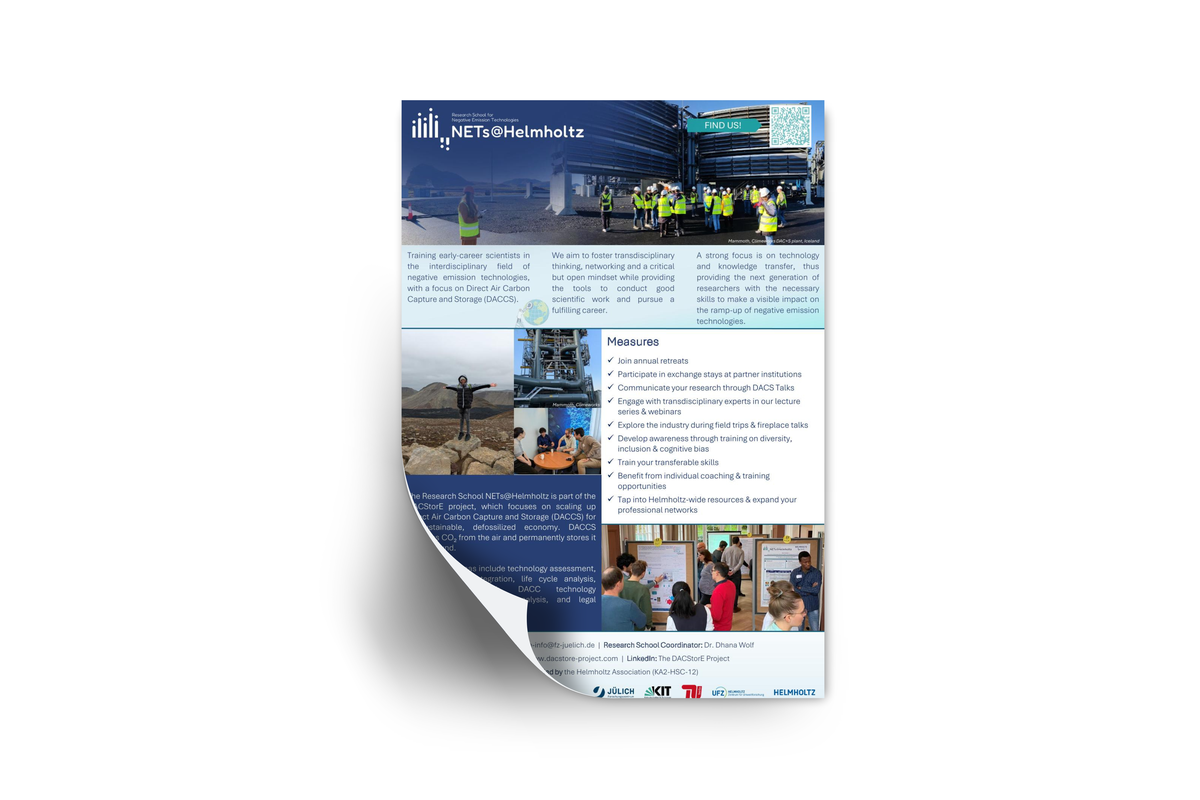
The DACStorE Research School Flyer
The DACStorE Research School trains scientists in the interdisciplinary field of research with a special focus on Direct Air Carbon Capture and Storage (DACCS). As part of the DACStorE project, it imparts scientific skills, promotes transdisciplinary thinking and networking, and supports researchers in actively shaping their careers. Through a strong focus on technology and knowledge transfer, participants are empowered to make a visible contribution to the responsible ramp-up of negative emission technologies and the transformation towards a sustainable, defossilised economy.
Interesting Links
International Energy Agency (IEA) – Direct Air Capture Overview (ieg.org)
- The page explains that DAC technologies can extract CO₂ directly from ambient air at any location, unlike point-source capture. The captured CO₂ can be permanently stored in deep geological formations or utilised in various applications. It highlights that DAC is very energy- and cost-intensive due to low atmospheric CO₂ concentration. Innovations - such as producing synthetic fuels from air-captured CO₂ and hydrogen—could help advance the technology.
Climeworks – Direct Air Capture Technology Explained (climeworks.com)
- The page presents Climeworks’ modular, filter-based Direct Air Capture technology that removes CO₂ from ambient air, concentrates it using renewable energy or waste heat, and stores it—often permanently underground, such as in Iceland. DAC is highlighted as a key climate solution: scalable, measurable, requiring minimal land footprint.
Global Direct Air Capture Projects and Industry Overview (long-intl.com)
- The page provides an overview of existing and planned DAC projects worldwide, including a process flow diagram. It describes technologies for capturing CO₂ from ambient air and options for its usage or storage. Companies like Occidental Petroleum, CarbonCapture Inc., and 1PointFive are featured. It also highlights funding efforts, such as US DOE support for DAC facilities through 2029. Finally, it references key developments in the CO₂ capture value chain and infrastructure.
- The BMWK emphasizes that achieving climate neutrality in Germany requires not only reducing emissions but also deploying Negative Emissions Technologies (NETs) such as Direct Air Capture (DAC), BECCS, and biochar. These approaches aim to actively remove CO₂ from the atmosphere. Although currently costly and uncertain, the German government is investing in research and development to enable their responsible and complementary use in climate policy.
Carbon Engineering – Direct Air Capture Process (carbonengineering.com)
- The website describes Carbon Engineering’s Direct Air Capture process, where ambient air is filtered through a sorbent that absorbs CO₂. The CO₂-rich sorbent then undergoes a regeneration phase, concentrating and purifying the captured CO₂ for storage or utilization.
AirCapture – CO₂ Capture Technology (Video) (aircapture.com)